
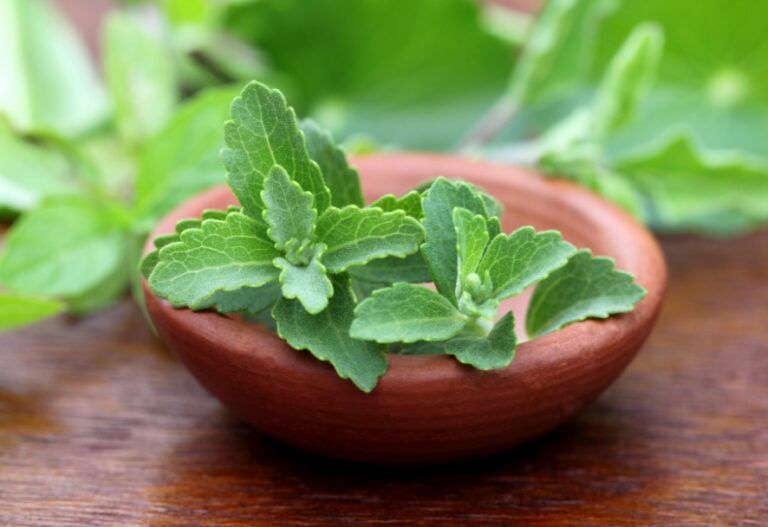
Stevia
Stevia is one of the most popular sugar substitutes and is now processed in many foods. The leaves of the Stevia plant contain sweet-tasting plant compounds (steviol glycosides), which are increasingly used in the food industry as a sugar substitute. The end product, after the chemical processing of the plant compounds, is processed as a sweetener in foods under the designation E 960 and is listed in the ingredients list.
Steviol glycosides are calorie-free, unlike regular table sugar, which contains about 400 kilocalories per 100g. The body excretes them undigested, which means that, unlike the consumption of table sugar, blood sugar levels do not rise.
Thus, Stevia is suitable as a sugar substitute even for diabetics.
Polydextrose
This is a sugar substitute that is processed in various foods under the designation E1200. Polydextrose is a condensation product of glucose, sorbitol (sugar alcohol from fruits), and citric acid. The body also excretes this sugar substitute without fully digesting it. With 100 kilocalories per 100g, it contains more calories than Stevia, but still significantly less than regular table sugar.
Thus, Polydextrose has a slight effect on blood sugar levels, but is in any case better for diabetics than consuming sweets that contain table sugar.
Since Polydextrose does not taste sweet on its own, it is often combined with other sweeteners to achieve a sweet flavor.
Maltitol
Maltitol is produced by the hydrogenation of maltose. Maltose is also known as malt sugar, which is a breakdown product of starch. It belongs to the group of polyols. The sugar alcohol is thus derived from fruits.
Maltitol has about half the calories of regular table sugar, so 240 kilocalories per 100g. As mentioned above, regular table sugar contains 400 kilocalories per 100g.
Since Maltitol contains no glucose, this sugar substitute is also suitable for diabetics, as it has no effect on blood sugar levels.
Erythrit
Erythrit is also classified as a sugar alcohol, whose chemical compounds taste sweet but are not metabolized like regular table sugar. Erythrit is obtained through fermentation, for example, from glucose.
Also, Erythrit is excreted undigested by the body, which means it has no effect on blood sugar levels. Regarding calories, it can be said that per 100g Erythrit contains about 20 kilocalories. Here, too, there is a significant difference compared to table sugar.
Xylit
Xylit is a sugar substitute that is also known as birch sugar, as it was originally obtained from the bark of the birch tree. In the meantime, it is mainly derived from various berries and fruits, but due to its chemical processing, it cannot be referred to as a natural sugar substitute. Since Xylit is an intermediate product of carbohydrate metabolism, it also occurs in human tissue.
Xylit is listed in the ingredients list of processed foods under the designation E967. It is an insulin-independent digestion, which is why this sugar substitute is suitable for diabetics. It contains about 240 kilocalories per 100g, which is about half as much as conventional table sugar.
In our shop, you will find a wide selection of the respective sugar alternatives. Simply use our categories or the filter function.
Share